The Third Place: Neither Home nor the Office
Explore the rise of the 'Third Place' driven by hybrid work, examining market trends, data and the growing demand for spaces beyond home and the office.


The Third Place: Neither Home nor the Office
You get off the bus one stop early and pop into a café instead of heading straight home. At the weekend, even with no urgent work to do, you buy a day pass for a coworking space anyway.
It might seem like nothing more than a personal habit or lifestyle choice, but it's a pattern that's appearing time and again in the way people use urban spaces and in wider workplace trends. So why has the idea of the "third place" become so relevant again?
In this article, we'll explore what's driving the renewed demand for these in-between spaces and what the data tells us about how people are choosing to work, meet and spend their time.
Where the concept comes from: Oldenburg's "Third Place"
The term "third place" was coined by the American sociologist Ray Oldenburg in his 1989 book The Great Good Place. He described the home as the first place, the workplace as the second place, and informal public settings where people could gather freely, without obligation, as the third place. Cafés, bookshops, neighbourhood pubs and barbershops were among his classic examples, and the idea has remained influential in urban sociology and community design ever since.
It's worth noting that Oldenburg never intended the third place to be somewhere people worked. Instead, he saw it as a space for casual conversation, a sense of belonging and informal social connection.
More recently, however, the idea has taken on a different meaning. Many companies now create café-style lounges and communal areas within their offices, hoping to encourage spontaneous conversations and stronger workplace relationships. In that sense, the third place has gradually shifted from a community-focused concept to one that's often linked to collaboration and productivity.
Why it matters now: the structural effect of hybrid work
The renewed interest in the third place closely reflects the rise of hybrid working. According to ONS figures published in June 2025, 28% of working adults in Great Britain now work in a hybrid arrangement, rising to 45% among those earning £50,000 or more. Separate GOV.UK rresearch also found that 79% of employees have access to some form of flexible working, while 57% make use of hybrid working.
The challenge is that working remotely doesn't necessarily mean home can serve as both a productive office and a place to properly switch off. When the boundaries between work and home become blurred, many people begin looking elsewhere for that sense of separation. Increasingly, that need is reflected not only in everyday behaviour, but also in the data.
What the UK market data shows
The numbers suggest this shift isn't just anecdotal — it's happening at scale.
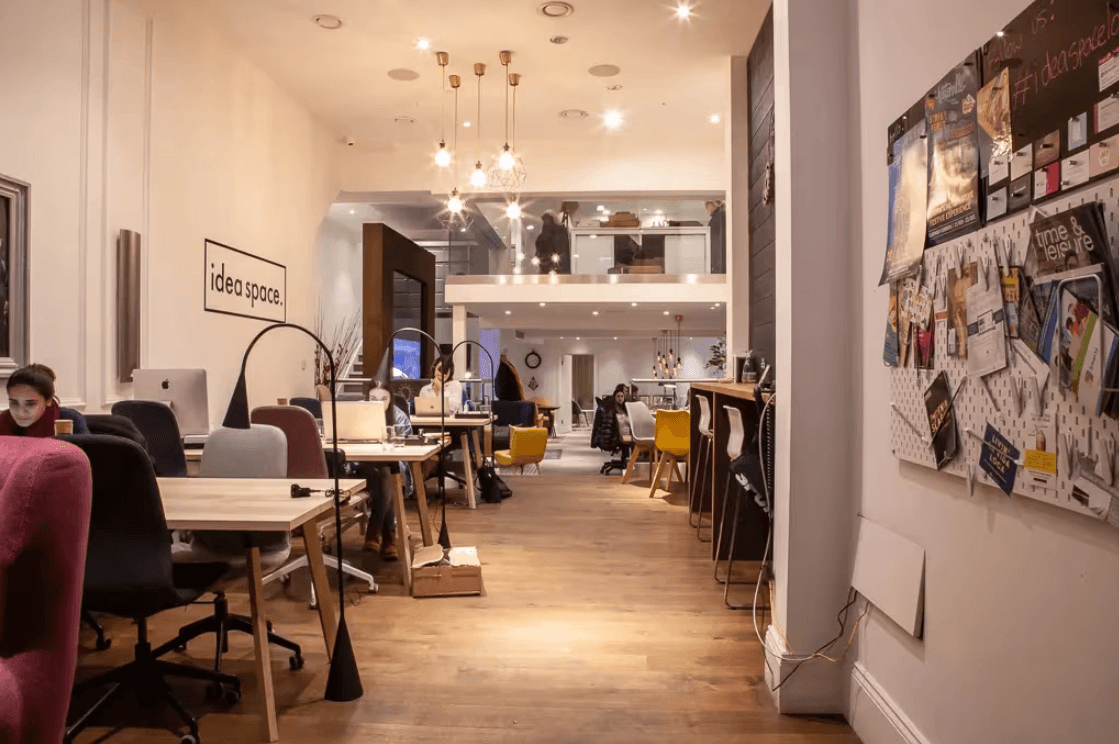
As of the first quarter of 2026, there were 4,550 coworking spaces across the UK and Ireland, with 4,270 located in the UK. London remains the largest market, with 1,209 locations, while regional cities are continuing to grow, including Manchester (123), Glasgow (72) and Birmingham (68).
The market is also expanding steadily. The number of coworking spaces in the UK grew by around 8.4% during 2025, with growth increasingly spreading beyond London into commuter towns and well-connected regional centres, rather than being concentrated solely in the capital.
Demand has remained strong, too. Occupancy rates were typically between 80% and 90% throughout 2025, while the average contract length increased to 22 months, suggesting that flexible workspaces have become an established part of the commercial property market rather than a short-lived experiment.
That trend is reflected in the market's value. The UK coworking sector was worth USD 1.94 billion in 2025 and is forecast to reach USD 2.99 billion by 2031, representing a compound annual growth rate (CAGR) of 7.45%.
Taken together, the figures point to a clear conclusion: using a third place is no longer simply a lifestyle preference. It's becoming a practical response to the way hybrid work has reshaped where—and how—people choose to work.
A word of caution on the concept itself
Not everyone sees the rise of third places as entirely positive. A widely discussed article in the American food publication Eater, titled "There Is No Such Thing as a True Third Place," argues that as the term becomes increasingly commercialised, it risks losing the very qualities that made Oldenburg's original idea meaningful: spaces that are welcoming to everyone, affordable to spend time in, and open to spontaneous encounters.
The concern is that when cafés and coworking spaces become centred entirely around memberships, purchases and productivity, they move further away from Oldenburg's vision of a neutral, shared space where people can simply exist without expectation.
As the third-place market continues to grow, the challenge is maintaining the qualities that made the concept valuable in the first place — the freedom to be there without a specific purpose, and the chance for unexpected connections to happen.
The real challenge isn't finding space — it's finding the right one
More supply doesn't necessarily make it easier to find a space that actually fits your needs. With more than 4,000 coworking and flexible office locations across the UK, and prices varying significantly by location, demand and time of day, the challenge is no longer simply availability — it's choosing well.
What people need from a third place can change from one day to the next. It might be a quiet corner for focused work, a more social environment for meeting others, or somewhere convenient to drop into between commitments. The right choice depends on more than just a postcode.
SpaceBiz is designed around this gap: helping people navigate a growing number of options by matching them with spaces based on their purpose, timing, location and budget. As hybrid working becomes a long-term part of how people work, the ability to connect people with the right space — not just more spaces — will become increasingly important.
Sources
Ray Oldenburg, Wikipedia entry
Steelcase, Third Places in Culture — Ray Oldenburg Q&A
Working From Coffee Shops, Coworking Statistics UK 2026
CoworkingCafe, Coworking Industry Report Q1 2026: UK & Ireland
Optix, UK Coworking Market: Trends, Occupancy, and Pricing 2025
Mordor Intelligence, UK Co-Working Office Spaces Market Size & Share
Note (とかみ), Can Coworking Become a "Third Place"?
Frequently Asked Questions
What is the 'Third Place' concept according to Ray Oldenburg?
Ray Oldenburg defined the 'Third Place' as informal public spaces outside the home (the first place) and workplace (the second place). His examples included cafés, pubs and bookshops — places designed for casual social connection and community rather than productivity.
How has hybrid working influenced demand for third places?
The rise of hybrid working has blurred the line between home and work, making it harder for home to function as both a productive workspace and a place to switch off. As a result, many people are turning to third places to create a clearer separation between work and personal life.
Are all commercial spaces considered true 'third places'?
Some critics argue that commercial spaces like cafés and co-working facilities, when primarily driven by paid membership or consumption, may diverge from Oldenburg's original ideal of accessible, obligation-free 'neutral grounds' fostering serendipitous encounters.
How does SpaceBiz help people find suitable third places?
SpaceBiz helps people navigate the growing number of third places by providing personalised matching. It connects users with spaces that fit their needs, taking into account factors such as atmosphere, time of day, location and budget. Instead of browsing endless options, users can find a space that better matches how they want to work, meet or spend their time.